

Planning a blog can feel easy until you sit down and try to turn a few ideas into a focused post.
What should you write about? What questions are your customers asking? Which keywords should you target? How should you organize the article? And how do you keep your blog from sounding like every other post online?
AI can help answer those questions, especially during the planning stage.
Instead of simply asking AI to "write a blog about my business," you can use it as a brainstorming partner. The right prompts help you uncover topics, research your audience, organize your ideas, and build a stronger foundation before you start writing.
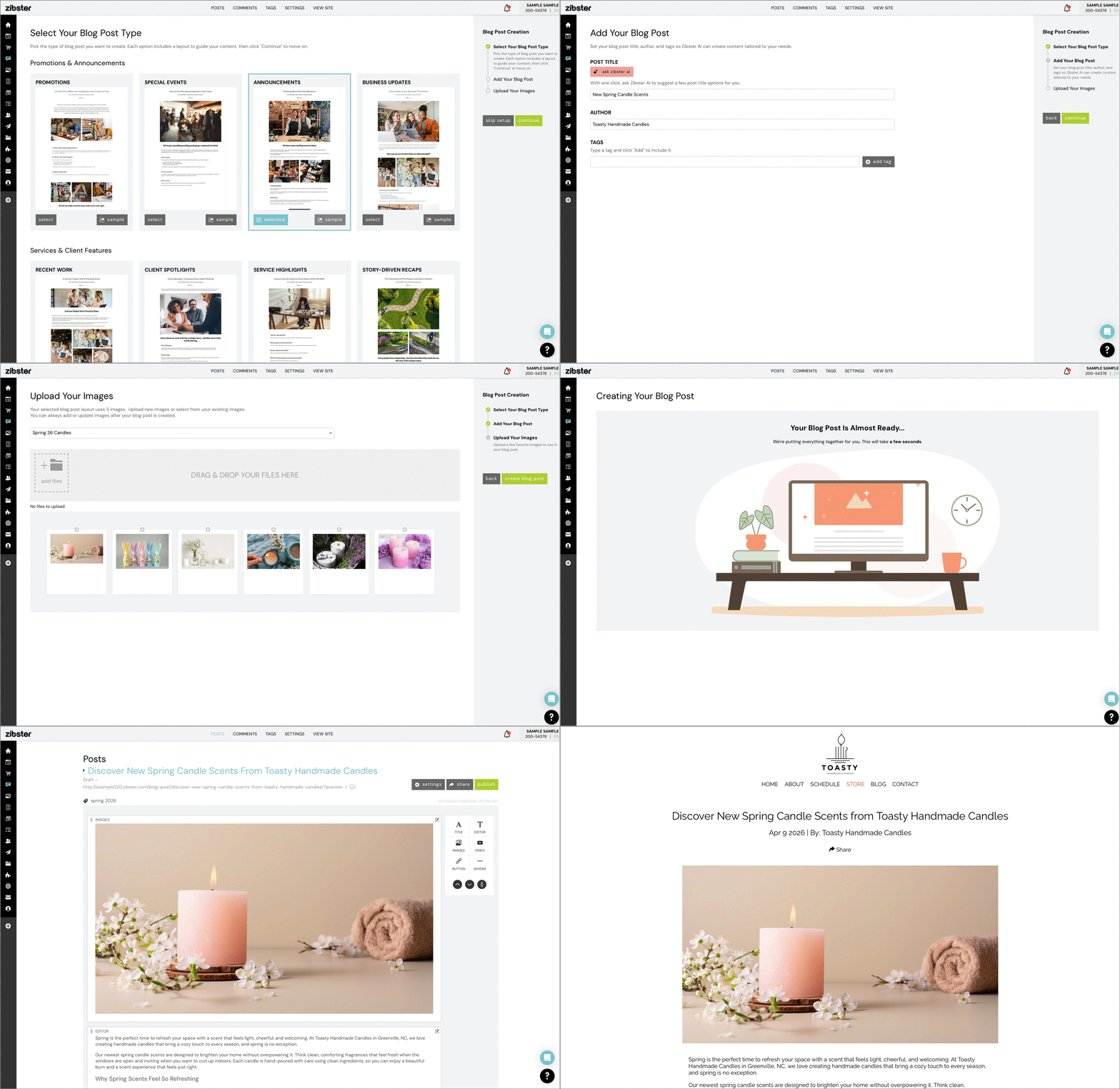
If your website is built with Zibster, you can take those ideas directly into the Zibster AI Blog Creator, which helps you move from an idea to a structured blog post faster. You can choose a blog topic type, use prompt ideas, or write your own.
1. Brainstorm Topics
If you are starting from nothing, go wide.
Give AI some information about your business, audience, and services.
I own a [type of business] in [location]. My primary customers are [describe your audience]. My main services are [list services]. Give me 20 blog post ideas that would answer common questions, educate potential customers, and help people discover my business through search engines.
If you already have a topic in mind, go narrow.
One broad subject can become several focused articles.
I want to create content about [topic]. Give me 15 specific blog post ideas related to this topic. Each idea should focus on a different customer question, problem, or search intent.
Instead of writing one long article about your main service, you could create separate posts about pricing, timelines, preparation, what to expect, and how to choose the right provider. That gives you more content while letting each article answer a specific question.
Zibster users can also use the AI Blog Creator to generate topic ideas based on their business information, including services, location, and brand.
2. Start With the Questions Customers Ask
The best blog topics usually come straight from customer questions.
Think about the conversations you have before someone hires you, books an appointment, or places an order.
Try this prompt:
I am a [type of business]. What questions might someone ask before hiring a business like mine? Focus on questions they might search for on Google before they are ready to contact me.
That could lead to topics like:
- How much does [service] typically cost?
- How long does the process take from start to finish?
- What should I have ready before our first appointment?
- How far in advance should I book?
- What areas do you serve?
- What is included, and what costs extra?
Each question can become its own blog post.
3. Understand What People Are Searching For
Keywords matter, but so does the reason behind the search. Someone comparing options needs something different than someone ready to buy.
These two prompts work together in one sitting. The first tells you what the article needs to cover. The second tells you what words to use while covering it.
First, figure out what the searcher wants.
Someone searches Google for "[SEARCH PHRASE]." What are they most likely trying to learn, compare, decide, or accomplish? What questions should a useful blog post answer to satisfy that search?
Then, find the language your customers use.
My blog topic is "[TOPIC]." Give me a list of primary keyword ideas, related search phrases, questions, and supporting topics that could naturally appear in an article about this subject.
Doing them in that order keeps you focused on writing something useful, rather than building an article around a keyword just because you want to rank for it.
Review the suggestions and decide which terms make sense for your business. AI keyword ideas are brainstorming suggestions. If search volume and competition matter to your strategy, verify them with dedicated SEO research tools.
4. Create a Blog Outline
Once you have your topic, use AI to organize it. A good outline keeps the article focused and prevents you from circling the same idea twice.
Try this prompt:
Create a detailed blog outline for an article titled "[BLOG TITLE]." The audience is [describe audience]. The goal of the article is to [educate/inspire/generate inquiries/etc.]. Include an introduction, useful section headings, common questions to answer, and a conclusion with a natural call to action.
Treat the outline as a starting point. Add your own experience, cut sections you do not need, and rearrange until the structure fits what you want to say.
5. Write for Your Local Area
Local content is some of the most valuable content a service business can publish.
Try this prompt:
I am a [type of business] serving [city/region]. Give me 20 locally focused blog ideas that would be useful to potential customers in this area. Avoid simply adding the city name to generic blog topics. Focus on genuinely local questions, locations, seasons, events, or considerations.
This might lead to articles about local regulations that affect your work, seasonal conditions in your area, neighborhood-specific advice, or what to expect from businesses like yours locally.
6. Plan Your Seasons and Build a Calendar
Seasonal posts are much easier to create when you plan them before the season arrives.
First, build your list of seasonal topics.
Create a 12-month list of seasonal blog topics for a [type of business]. Include holidays, weather changes, busy seasons, customer planning periods, and other events that could affect when people are searching for my services.
When you have the list, work backward from when people search. If customers start looking in August for something you deliver in October, that article needs to publish in July.
Then, turn the list into a schedule.
Include your business priority in the prompt. A calendar built around what you are trying to sell is more useful than one built around variety alone.
Create a three-month blogging calendar for my [type of business]. I want to publish [number] blogs per month. My biggest business priority during these three months is [goal]. Balance educational articles, service-focused content, local SEO topics, customer questions, and seasonal content, and make sure several articles naturally support that priority without making every post promotional. Explain the purpose of each post.
Now your blogging schedule is connected to what you actually want the business to do.
7. Fill Gaps and Build on What Works
You may already have useful articles on your website. Both of these prompts start from content you have already published, but they solve different problems. Use whichever one fits your situation.
If you have a lot of posts and no idea what is missing.
Provide a list of your existing blog titles and ask:
These are the blog posts currently on my website. Analyze the topics and identify important customer questions, services, or subjects I have not covered yet. Recommend 15 new articles that would fill those gaps instead of repeating my existing content.
If one post is clearly performing better than the rest.
This blog post about [TOPIC] performs well for my business. Give me 10 related blog ideas that explore more specific questions or natural follow-up topics without repeating the original article.
That builds small clusters of related content around the subjects that matter most to your customers.
8. Add Your Own Experience
Your experience is what makes your content different from everything else on the subject.
Before writing, ask:
I am creating a blog about [TOPIC]. Give me 10 questions about my personal experience, opinions, process, customers, or business that I should answer before writing. The goal is to make the article more original and based on my real expertise.
Answer those questions yourself. Your answers become the stories, examples, and recommendations throughout the article. That is where AI stops being the author and starts being a useful assistant.
Create a Reusable Blog Planning Prompt
You can combine several of these into one prompt you use every time.
Copy and customize this template:
I am a [TYPE OF BUSINESS] located in [LOCATION]. My primary audience is [AUDIENCE], and my services include [SERVICES].
I want to create a blog about [TOPIC].
Help me plan the article by providing:
- Five possible titles
- The likely search intent behind the topic
- A primary keyword and related keyword ideas
- Five questions readers will probably want answered
- A detailed blog outline
- Ideas for personal stories or professional experience I could add
- Internal pages or related blog topics I could potentially link to
- A natural call to action for the end of the article
Do not write the full article. Help me create a useful plan that I can customize with my own knowledge and experience.
Save it somewhere easy to find. The next time you need a blog, you already have a process.
Put Your Plan to Work With the Zibster AI Blog Creator
Planning is valuable, but eventually you need to turn that plan into a post.
Zibster AI is built directly into your blogging workflow, so you are not moving between a separate AI tool, a document, and your website. It uses information from your Business Profile to create content based on your business, services, location, style, and brand voice.
Use the prompts above to decide what you want to say, then use the Zibster AI Blog Creator to turn that direction into a structured post. It also handles the content small businesses publish most often: new services, customer spotlights, tips and how-tos, appointment preparation, behind-the-scenes stories, promotions, and business updates.
Once AI generates your draft, you are still in control. Edit the content and use Ask Zibster AI within the Blog Editor to expand, rewrite, or improve individual sections. The best results come from combining AI-generated content with your own experience and details.
The workflow looks like this:
Plan the topic → Generate the draft → Add your expertise → Edit → Publish
You know blogging helps you get found. The hard part is finding topics and writing the posts. Take that off your plate and staying consistent gets a lot easier.
AI Should Help You Plan, Not Replace You
You do not need to hand your entire blog over to AI to benefit from it. Some of the best uses happen before and during writing.
Use it to brainstorm. Ask questions. Explore angles. Create outlines. Look for gaps. Then bring your own knowledge, stories, examples, opinions, images, and personality into the article.
The goal is not to publish more generic AI content. The goal is to spend less time staring at a blank page and more time creating content that represents your business, answers your customers' questions, and gives people another reason to find you online.


Leave a comment
0 Comments